
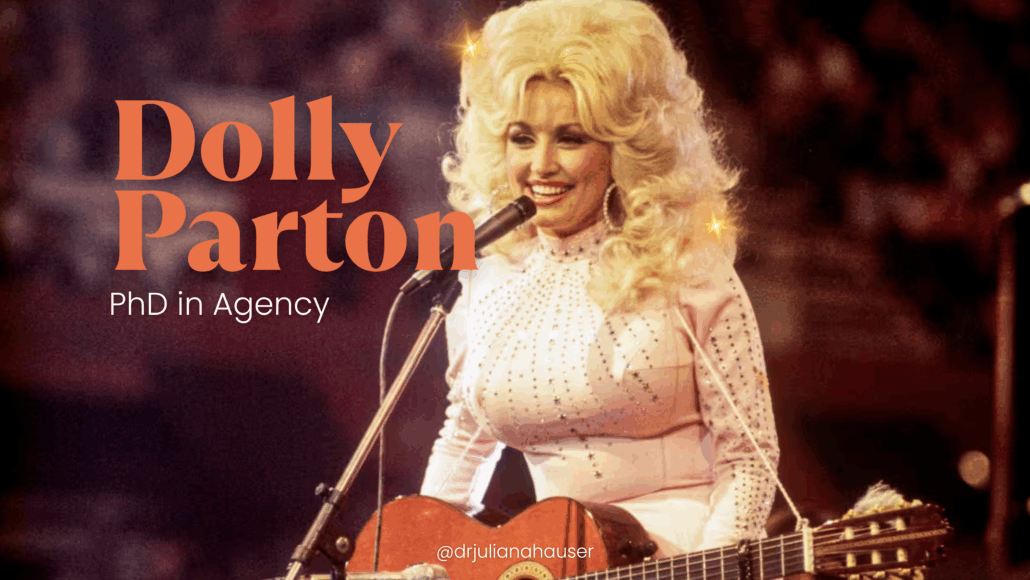
Someone said today that Dolly Parton may have been the last person in America with no enemies.
Obviously, that isn’t likely true. Someone somewhere surely disliked Dolly Parton, but we all know what that person meant. And I bet, like me, you paused and thought it just may be true.
Because in an increasingly divided world, Dolly somehow belonged to everyone.
Women loved her. Men loved her. The gay community loved her. People from all socio economic levels loved her. Country people loved her. City people loved her. Church ladies loved her. Drag queens loved her. Feminists loved her. Kids loved her. People from the north, south, east, and west loved her. Despite all the ways we can “organize” people, WE loved her. People who would probably disagree about almost everything else could agree on Dolly.
I’ve been thinking about why.
Of course she was enormously talented. She was funny. She was generous. She wrote extraordinary songs. She was memorable in looks and quips and personality.
But I think there was something else.
Dolly Parton may have had the closest thing I’ve ever seen to a PhD in agency.
And I think that’s a large part of why we loved her.
Dolly knew who Dolly was.
Agency is a concept I’ve spent years thinking about, teaching and writing about. At its core, agency is the ability to know yourself, to recognize that your life belongs to you, and to make choices from that knowledge.
It sounds simple. It isn’t.
Most of us spend enormous portions of our lives trying to figure out who we’re supposed to be.
Who is a person that people will love?
What will they approve of?
What will make them take me seriously?
What if I’m too much?
What if I’m not enough?
Dolly seemed to figure out remarkably early that she wasn’t particularly interested in becoming the version of Dolly Parton other people found most acceptable.
And people certainly tried.
Early in her career, record executives wanted to make her more sophisticated. Flatten the hair. Change the clothes. Tone everything down.
Dolly tried it. She hated it.
Her eventual response was essentially: I have to look like me.
Years later, she wrote something even simpler” “I knew who I was.”
There may not be a better prerequisite for agency.
She understood something about being underestimated.
One of my favorite Dolly lines has always been:
“I’m not offended by all the dumb blonde jokes because I know I’m not dumb…and I’m not blonde either.”
That is funny. And it’s also psychologically sophisticated.
She didn’t require other people’s perception of her to match her perception of herself.
Think about how much freedom there is in that.
Most of us spend an extraordinary amount of energy trying to correct what other people think about us.
No, you don’t understand me.
I’m actually very smart.
I’m actually successful.
I’m actually a good person.
Please see me correctly.
Dolly seemed to understand:
You can misunderstand me without making me misunderstand myself.
That’s agency.
And perhaps that’s why she could laugh so easily at herself. The joke couldn’t destroy her because her identity wasn’t hanging on whether you got the joke.
In the famous 1977 Barbara Walters interview, Walters asks her about the wigs, the clothes, her body, her background and whether people think she’s a joke.
Dolly doesn’t crumble.
She doesn’t become angry.
She doesn’t launch into a defense of her intelligence or accomplishments.
She essentially says: I know people make fun of me. That’s okay. I know who I am.
She talks about being sure of herself, sure of her talent, sure of her love of life.
And then she keeps the hair.
That may be one of my favorite examples of agency I’ve ever seen.
She still chose herself.
There are hundreds of stories from Dolly’s career that we know and probably a million more we don’t know, but I keep returning to one.
Porter Wagoner gave Dolly one of her biggest professional opportunities. She was grateful to him. She loved him.
And eventually, she needed to leave him.
Porter didn’t want her to go.
Dolly went anyway.
And she wrote I Will Always Love You to say goodbye.
If you were like me, my first exposure to that song led me to think it was about a romantic love. When I learned the origin of her story writing, it entirely changed the impact of that song for me.
It’s not simply a love song. It’s an agency song.
One of the hardest lessons many of us ever learn is:
I can love you and still leave. (Oh how I wish I had learned this much earlier in my life.)
I can be grateful for what you gave me without giving you ownership of my future.
I can honor what we were without agreeing that it is what we must always be.
Love and self-determination do not have to be enemies.
Sometimes the most loving sentence we can say is:
I will always love you.
And sometimes the next sentence still has to be:
And I have to go.
It is an example of honesty, accountability, saying the hard thing instead of avoidance and an example of not abandoning yourself.
I think Dolly understood something that goes beyond individual agency.
The more secure we are in our own agency, the more capable we become of allowing other people theirs.
This is the part I keep thinking about when I consider why so many different kinds of people loved Dolly Parton.
She didn’t seem to need everyone else to become Dolly.
She was deeply religious without requiring everyone else to believe what she believed.
She was married to the same man for nearly sixty years and could support people whose relationships looked nothing like hers.
She was extraordinarily feminine without suggesting that femininity was the correct way to be a woman.
She became tremendously wealthy without pretending she hadn’t come from poverty or pretending she wasn’t wealthy.
She could be glamorous without contempt for people who weren’t.
She could be certain of herself without requiring everyone around her to be wrong.
That’s a very mature form of agency: My life belongs to me and yours belongs to you.
Dolly once said: “I think everyone should be with who they love.”
And then, because she was Dolly, she added that gay couples should be encouraged to marry and “suffer just like us heterosexuals.”
There it is. Conviction without cruelty. Acceptance without self-erasure.
And humor right in the middle of it.
Agency isn’t selfishness.
I think we sometimes misunderstand this.
If I’m teaching someone to become more activated in their agency, I’m not teaching them to say:
I get to do whatever I want.
I’m helping them develop enough of a self that their choices can actually belong to them.
And when that happens:
We become less controlling. Less threatened. Less desperate for validation. More able to tolerate difference.
And ultimately, more capable of using our agency on behalf of people who haven’t yet been given as much of it.
Dolly did that too.
Her father couldn’t read or write.
She didn’t tell that story to make him small. She repeatedly described him as one of the smartest people she knew.
And then she asked a profound question:
What can I do with what I have?
She created the Imagination Library.
What began as a program for children in her home county eventually put hundreds of millions of books into the hands of children around the world.
That’s another dimension of agency we don’t talk about enough.
Agency isn’t only:
What do I want for my life?
Eventually it becomes:
What can I do with my life that increases the possibilities available to someone else?
That’s agency creating agency.
And Dolly did that over and over.
Maybe that’s why she didn’t seem to have enemies.
Not because she never had opinions.
Not because she never disagreed with anyone.
Not because she spent eighty years carefully avoiding anything controversial.
Dolly Parton was a woman who left the powerful man who helped make her famous.
She refused to give Elvis Presley the publishing rights to her song, even though it meant Elvis wouldn’t record it.
She dressed exactly as she wanted despite being told people wouldn’t take her seriously.
She sang about women’s sexual double standards.
She supported gay rights.
She built businesses.
She made enormous amounts of money.
She gave enormous amounts of money away.
She was hardly a woman without convictions but her agency rarely seemed to require an enemy.
And maybe that’s the part worth studying.
Because there is a version of empowerment that depends upon opposition.
I am powerful because you cannot control me.
Sometimes we need that version. Particularly when we are first finding our way out of something that has constrained us.
But there’s another version that comes later.
I am powerful because I know who I am.
I don’t need to defeat you.
I don’t need you to agree with me.
I don’t need you to understand the hair.
I don’t even need you to know it’s a wig.
I know.
And once I know, I have considerably more room to let you be you.
That’s the Dolly lesson I want to keep.
Agency is both a practice and a feedback loop.
The more we know ourselves, the more confidently we choose.
The more we make choices that belong to us, the more clearly we come to know ourselves.
Knowing creates agency. Agency reinforces knowing.
And eventually, if we’re fortunate, that security becomes spacious enough to make room for other people. Maybe that is what Dolly Parton mastered. She became so completely herself that she didn’t seem terribly threatened by anyone else being themselves.
Big hair.
Big breasts.
Big laugh.
Big talent.
Big ambition.
Big generosity.
Big heart.
Nothing muted to make the rest of us more comfortable.
And somehow, instead of making people feel smaller, Dolly’s bigness seemed to give everyone else a little more permission to be big too.
People leave behind songs.
People leave behind money.
And there are people who leave behind buildings with their names on them.
Dolly left all of those.
But she also left us an extraordinary demonstration of what a human being can look like when she knows:
This is who I am. This is my life. I get to choose what I do with it. And you get to choose what you do with yours.
Dolly Parton didn’t just have agency, she understood what agency is ultimately for.
To become more fully ourselves.
Thank you Dolly. You will be missed. We needed your spark and goodness especially now more than ever. And we are grateful you left a legacy for us to keep discovering.
Addendum:
I have a TEDx talk that addresses the concept and skill of agency as I see it. It already feels outdated because I learn so much more about it the more I learn more about it. And I learn more about me every time I sit in the wonderings of agency. I learn more about how to live better, love better and think better the more I learn and explore agency.
The night of Dolly’s death (I wanted to write shocking death or untimely death but I don’t know what adjective actually captures it best… on the night we all learned the dearest celebrity we adored died about 20 years before we hoped she would), I was with my son and his girlfriend at a local event for the Chamber Music Lex, listening to music moguls of a different sort (Zach Brock, Nathan Cole, Burchard Tang and Kuang-Hao)—all men introduced by another legend, a friend of mine Cacey Nardolillo. I didn’t know the men beyond their introduction but I do know my friend, Cacey, embodies a lot of what I admired in Dolly.
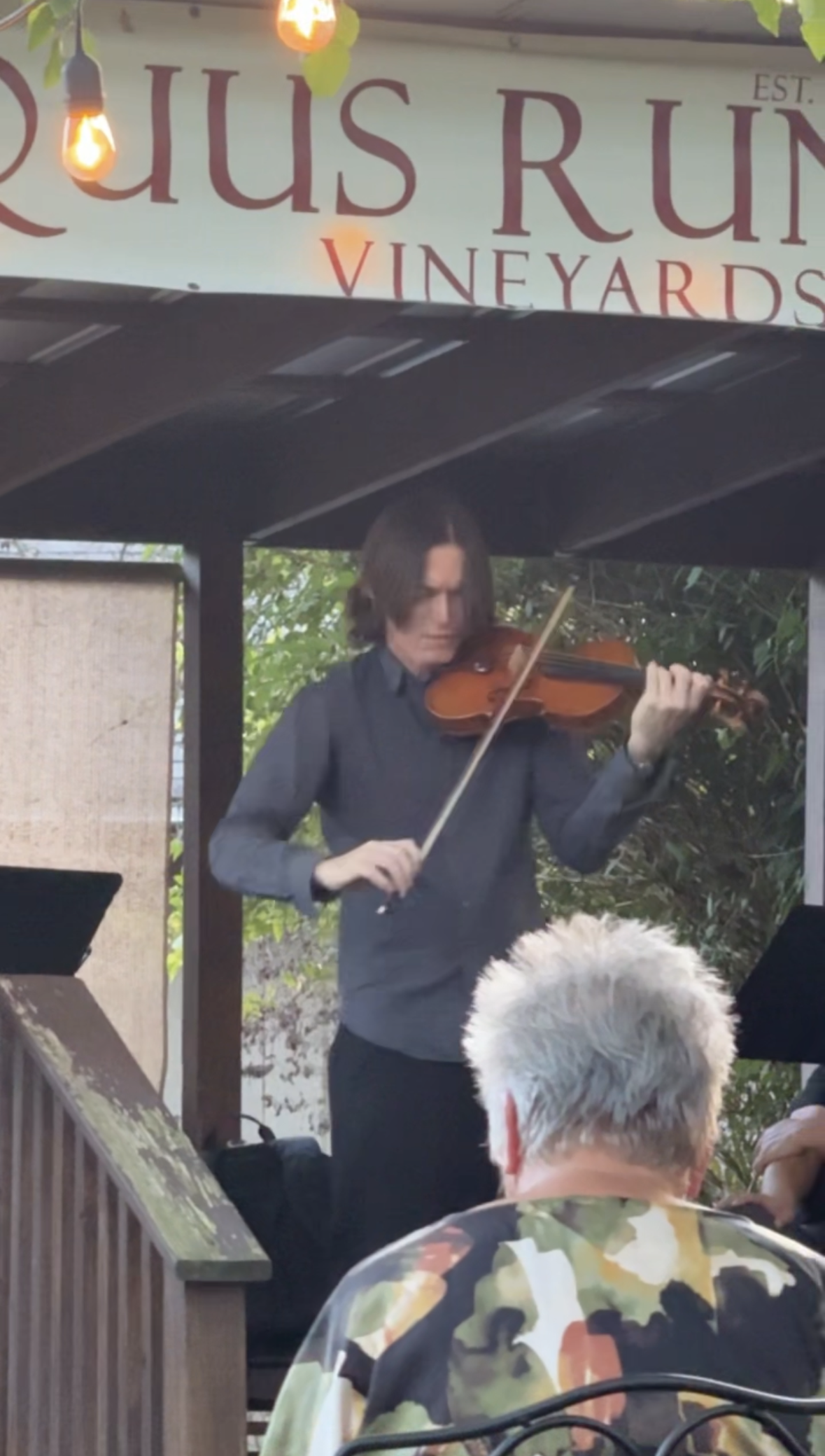
I was thinking about that as she introduced them—a powerful, talented, kind and humble woman as the executive director of this organization, calling in four incredibly talented men to play for a group of us who want to support the arts. We showed up to be dazzled by talent most people don’t know they have access to at a small winery in central Kentucky.
Dolly was on my mind and one of the violinists, Zach, a talented and accomplished musician said “I am doing an unexpected song spontaneously and you will know why when I start.” And I just knew what he was going to play. Through the improvisation you could hear the famous melody of Jolene. A Grammy winning, jazz violinist from Lexington Kentucky felt moved to give a touching and humble and yet also big tribute to Dolly. A wave of smiles crossed the faces of the audience members.
It was so very Dolly.